Drinking water · Treatment technology
Bottled Water Is Tap Water With Errands
How much bottled water moves through your year?
Edit all three assumptions. This counts the routine; it does not estimate an RO payback period.
The title is rhetoric. The errands are literal.
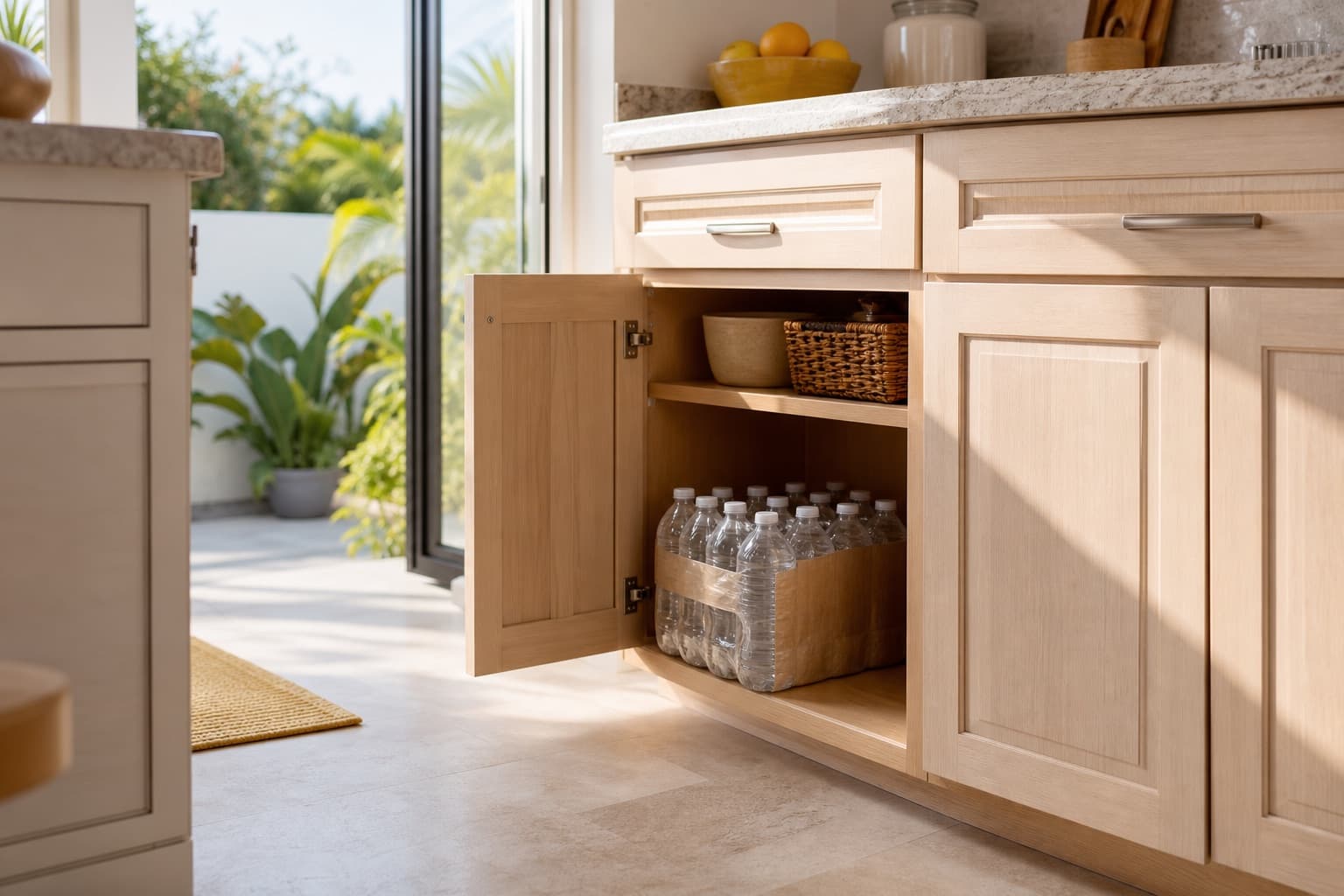
Not every bottled-water product starts as municipal tap water. The point is simpler: packaged water turns a daily household need into recurring shopping, carrying, storage and disposal.
A case in the pantry also becomes a small inventory system. Someone has to notice it is low, find room for the next one and handle every empty bottle afterward.
Count the routine before comparing alternatives.
The calculator below annualizes only the assumptions you enter. It does not estimate an RO payback period, predict future retail prices or assign a dollar value to your time.
Its job is to make the current routine visible: cases, bottles and spending across a year.
Reverse osmosis puts a different routine under the sink.
A point-of-use reverse-osmosis system treats water at one fixture for drinking and cooking. Pressure pushes water through a membrane, with a separate stream carrying rejected material away.
Performance depends on the product's specific certified contaminant-reduction claims and on timely filter and membrane maintenance. NSF/ANSI 58 is the relevant RO standard; it is not a promise that every RO system has the same claims.
EPA WaterSense: Point-of-use reverse-osmosis systems (opens in a new tab) NSF: Standards for residential water-treatment systems (opens in a new tab)
A new microscope found more—and raised better questions.
A Columbia-led PNAS study examined three unnamed bottled-water brands and found about 240,000 detectable plastic fragments per liter on average. Roughly 90% were classified as nanoplastics, particles small enough to have been missed by older methods.
That finding measures particles, not health outcomes. The health implications remain unresolved, so the responsible response is attention and continued research—not a health scare.
PNAS: Rapid single-particle chemical imaging of nanoplastics (opens in a new tab) Columbia University: Bottled-water nanoplastics research summary (opens in a new tab)
Efficiency belongs in the product decision.
RO systems send some water to drain while producing treated water. EPA says conventional point-of-use systems may send five or more gallons to drain for every gallon treated; WaterSense-labeled models are limited to 2.3 gallons or less.
EPA also advises choosing treatment for a defined need. An efficient, independently certified system with a clear maintenance plan is a more useful specification than the letters 'RO' alone.
EPA WaterSense: Point-of-use reverse-osmosis systems (opens in a new tab)
Primary sources
Read the reporting behind the story.
- PNAS: Rapid single-particle chemical imaging of nanoplastics (opens in a new tab)
- Columbia University: Bottled-water nanoplastics research summary (opens in a new tab)
- EPA WaterSense: Point-of-use reverse-osmosis systems (opens in a new tab)
- NSF: Standards for residential water-treatment systems (opens in a new tab)